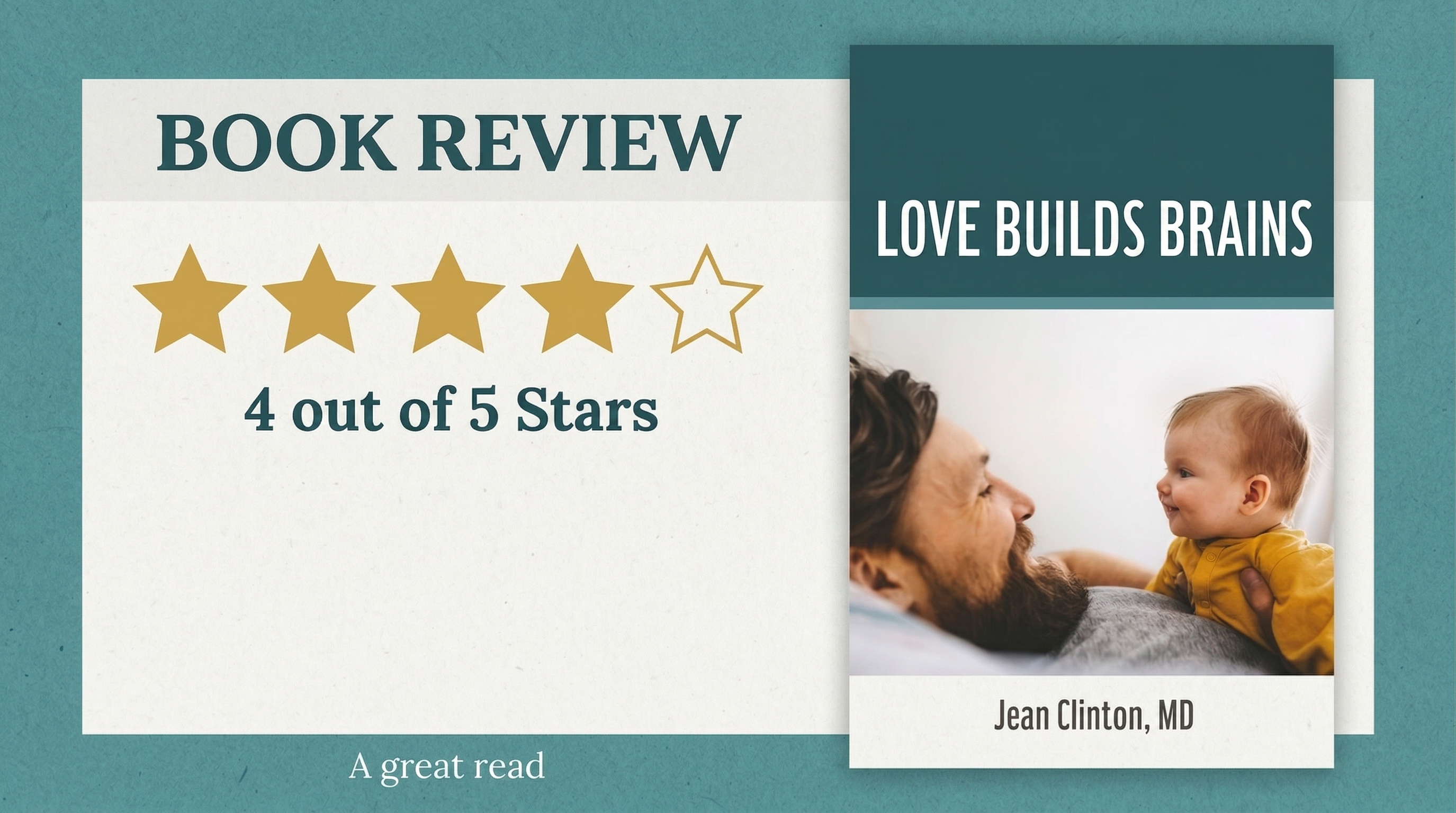
Jean Clinton is a Canadian developmental psychiatrist, and Love Builds Brains is her accessible, practitioner-facing argument that children’s behavior, learning, and long-term wellbeing are not primarily a matter of discipline or motivation. They are a matter of neuroscience, and more specifically, of relationships.
Quote of the Book
“Every child needs a person whose eyes light up when they walk in the room”
- Dr Jean Clinton
The brain is not a finished product
One of the most clarifying things Clinton offers in the early chapters is this: children are not born with fully formed brains. The brain develops in relationship with the environment, and that environment includes the emotional climate a child grows up in. Stress hormones, particularly cortisol, literally shape the developing brain. This means the coping patterns we see later in life are not simply bad habits or behavioral problems. They are the architecture of a brain that adapted to what it encountered.
This reframing matters enormously in classrooms. When we describe a student as “dysregulated” or “noncompliant,” we are often describing someone whose nervous system learned to operate a particular way under conditions that required it. That is not an excuse for the behavior. It is an explanation that should change what we do in response.
Throughout the book, Dr. Clinton frames the challenge of growing as “thank goodness adults are wired to find babies adorable and want to help them or no human would ever make it to adulthood.” I found myself wondering, reading these chapters, whether something similar happens in adolescence. Teenagers are also undergoing a significant neurological shift. They engage in risky, provocative behavior that seems designed to get adults involved. Is that also the brain doing what it needs to do, seeking scaffolding for a new stage of development? Clinton does not address that question directly, but she planted it.
Relationships are not a nice-to-have
The through-line of Love Builds Brains is not a metaphor. It is a scientific argument. Warm, consistent, responsive relationships are the mechanism by which healthy brain development occurs. Clinton returns to this in nearly every chapter, and it does not feel repetitive. It feels like emphasis. The word she circles around again and again is “connection.”
This carries real implications for how we structure early childhood education. Clinton references the Early Development Instrument, a Canadian population-level assessment that found 32 percent of children do not have the skills they need to be successful in school. She frames this as both a call for earlier support and a call to reexamine what kindergarten is actually for.
Something that I feel will resonate with many educators is something Dr. Clinton names “the tyranny of cognitive seduction.” This is the tendency to prioritize reading and writing instruction at the expense of the social-emotional learning that actually predicts long-term success. Reading by grade three does predict academic achievement, Clinton argues, because learning after that point depends on being able to read. But what predicts reading readiness? Socialization, play, and relationships. The things we often treat as preparation for school rather than as school itself.
This connects directly to the broader tradition in music education that informs my own practice. Kodály, Orff, and MLT all ground their pedagogy in the understanding that playful, culturally embedded musical experiences from early childhood are not just preparation for later learning. They are the learning. The research Clinton presents reinforces why that approach is not sentimental. It is developmentally sound.
A few notes on the reading experience
I want to be honest: the editing is uneven in places. The content is strong, and Clinton’s voice is warm and credible, but some sections have some uneven edits with obvious typos. This does not diminish the value of what she is saying, but some readers may find it distracting.
Who should read this book
Honestly? Everyone who works with children. Music teachers, classroom teachers, administrators, school counselors. Love Builds Brains is not dense or technical. It is written for practitioners, not researchers, and it reads quickly. The core message is simple enough to share with a parent at a conference and substantive enough to anchor a professional learning conversation.
Clinton offers a lens, rather than a curriculum or a checklist. Once you understand that a child’s behavior is often the visible surface of neurological development shaped by stress and relationship, you cannot unsee it. And once you cannot unsee it, your instinct to connect before you correct starts to feel less like a soft choice and more like the only sensible one.
Rating: 4 out of 5 stars

Love Builds Brains
Buy on Amazon