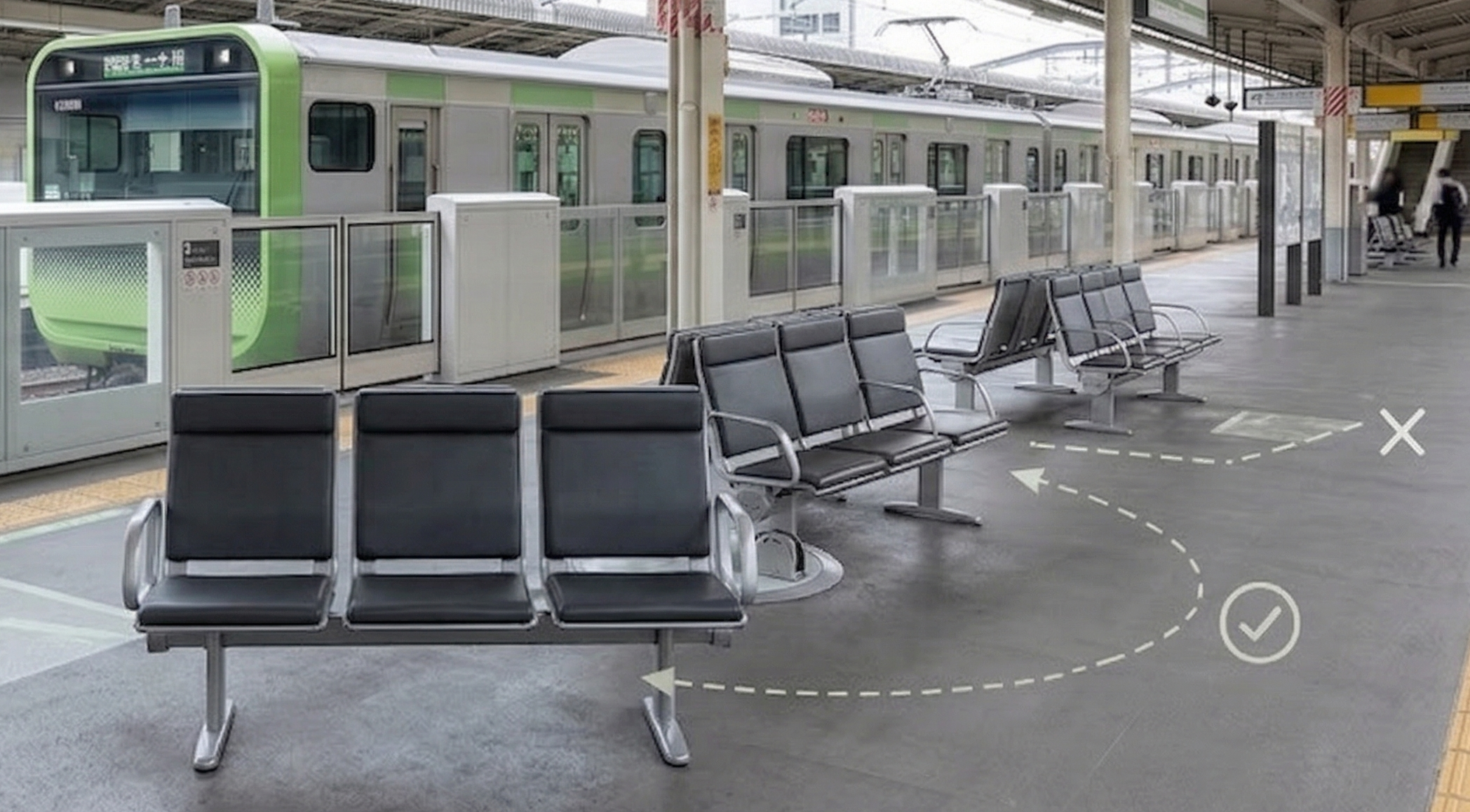
West Japan Railway had a problem that signage and staffing can’t fully solve: passengers — particularly those who have been drinking — stand up from platform benches and fall onto the tracks.
Their solution was not to add a warning. It was to rotate the benches 90 degrees.
That is the idea behind this post.
Your music room is already shaping how your students respond. The direction the chairs face, the distance between floor spots, the presence or absence of a designated calm space, and window coverings are not neutral features of the room. They are behavioral nudges. For students who are expressing their needs through behavior, those nudges either work for them or against them.
To design a room that works, you need to understand what behavior is communicating in the first place. That is where E.A.T.S. comes in.
Nudges not Control
It is tricky to talk about behavior management without feeling like we are talking about “control” and removing a student’s autonomy. The goal of classroom management is to nudge students into acting in a way that will help them learn well, be present, and be part of the group. For many of our students, including those with disabilities, that means building self-regulation and inhibition.Understanding E.A.T.S.: the four functions of behavior
Behavior doesn’t happen randomly. Research in applied behavior analysis tells us that behavior serves one of four functions: it helps someone escape an unwanted situation, gain attention, access a tangible item or activity, or find stimulation. These four categories make up E.A.T.S.
| Letter | Function | What it might look like in music |
|---|---|---|
| E | Escape | A student shouts “I need to use the bathroom” whenever a recording or video is played |
| A | Attention | A student who calls out, makes noise, or provokes peers to get a reaction |
| T | Tangible | A student acts out to receive their preferred drum, bean bag, or seat |
| S | Stimulation | A student who rocks, hums, fidgets, or seeks sensory input regardless of the activity |
Here is what makes E.A.T.S. so useful for music educators: once you know the function behind a behavior, you begin to see it in a different light and can design responses to it. Not just in the moment responses but responses built into the architecture of your room itself.
Additionally, your classroom layout can be preventative (designed to reduce the likelihood that behavior will occur) and supportive (designed to offer a path through behavior when it does). Both matter and both are achievable with low cost and a roll of tape.
Preventative design: building E.A.T.S. into your layout before the lesson starts
Escape: remove the escape routes that aren’t planned
Students who use escape-motivated behavior are usually communicating something real: the task feels too hard, the sensory input is overwhelming, or the social demand is too high. The goal isn’t to eliminate escape it’s to make sure the escape options you offer are intentional, not accidental. We are looking to help the student self-regulate so they can join in the learning.
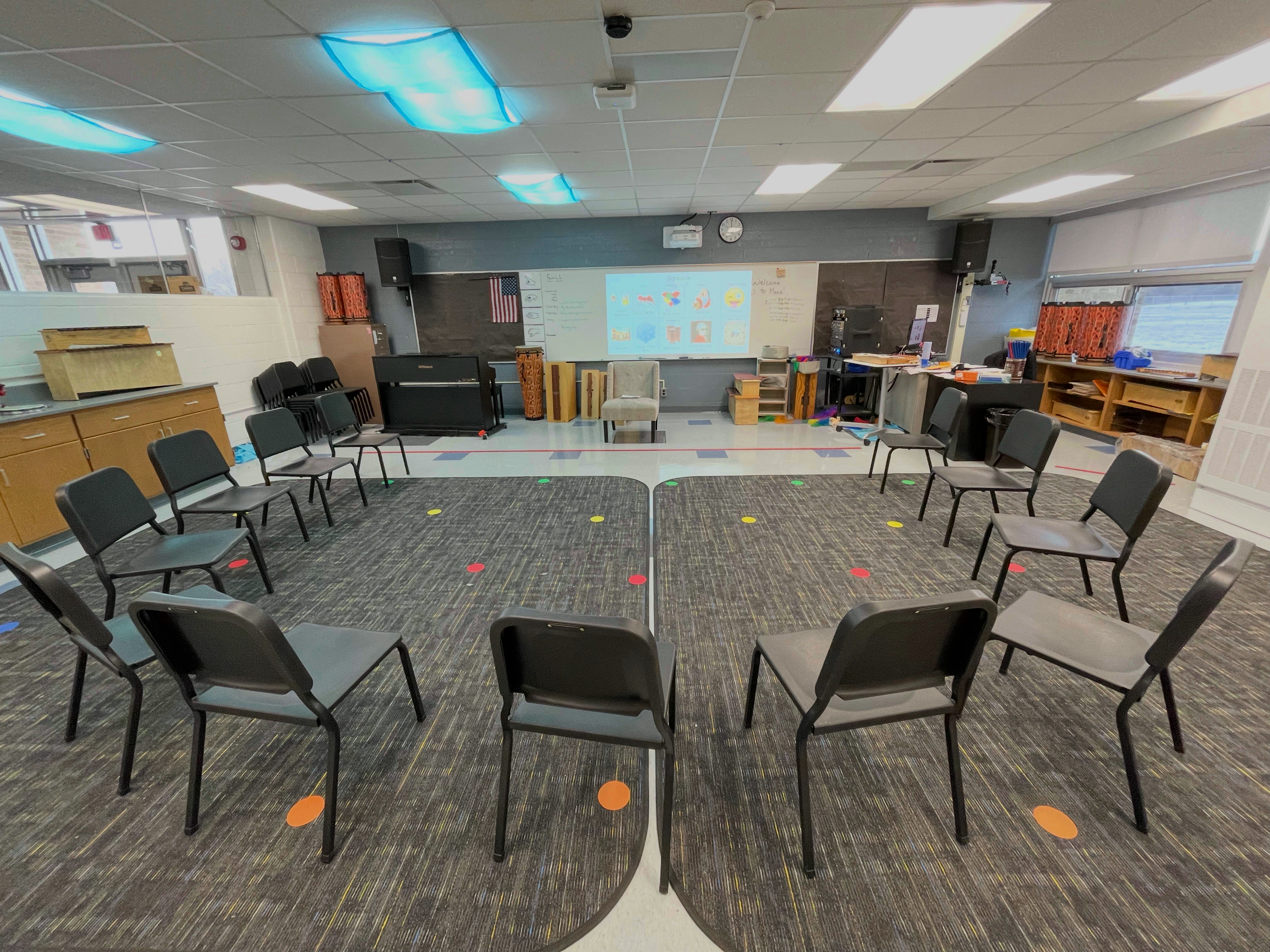
What does this look like in a layout? First, look at your seating arrangement. A semi-circle removes the back row. There is no low-visibility corner where a student can quietly disengage and go unnoticed. The semi-circle makes participation the default architecture of the space.
Second, and more importantly: if escape-motivated behavior is common in your room, build in a planned escape. A cool-down corner (a designated, visually bounded area with a simple calm-down prompt and a neutral sensory tool) gives students a legitimate way to step away temporarily. When students who have sensory sensitivities or anxiety know there is a sanctioned path out of an overwhelming moment (and that you will respect their request to use it!), they are less likely to create an unsanctioned one.
Attention: proximity makes attention sustainable
Students who seek attention from adults are not being manipulative, they are expressing a need for connection and acknowledgment. Your layout can either make that need easy to meet or turn it into a competition that drives escalation.
The semi-circle solves this too, from a different angle. When you position yourself at the open end of the arc, you are equidistant from every student. You can make eye contact with each person without crossing the room. You can move to any student in a few steps. That ease of proximity means you can distribute attention before students have to ask for it through behavior.
Intentional placement within the semi-circle matters here. Students who frequently seek attention often do best near your natural position. This is not a reward but because it makes it easier for you to provide brief, proactive check-ins before a bid for attention becomes a disruption.
Aim for a “4 positive to 1 negative” ratio of interactions for students. This is a goal for all students but especially for students who are seeking attention.
Tangible: show them when it’s coming
Behavior driven by tangibles can spike during transitions. A student who has difficulty waiting reaches for the drum before the lesson is ready. A student who has difficulty stopping keeps playing after the cue. A student who just really wants to touch a ukulele, will run over and touch a ukulele!
Your layout can address this through visual schedules and physical structure. A visual schedule at the front of the room or on the board tells students when instruments are coming. That preview reduces anticipatory behavior because the tangible is no longer a surprise. It’s a promised event with a known timeline.
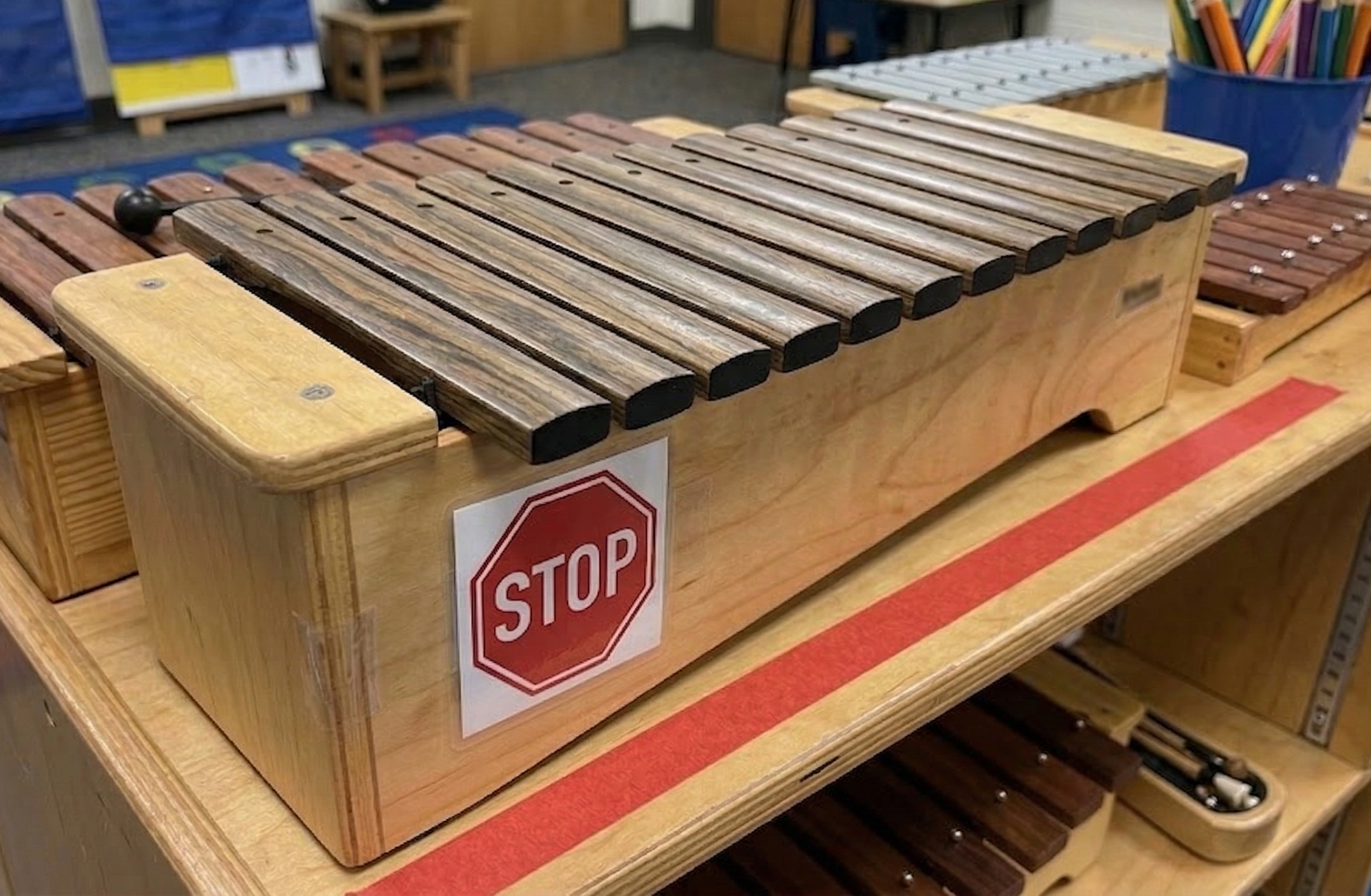
Red tape on the floor between the circle and the instrument storage area provides a physical “wait here” boundary that makes the transition cleaner. Students who have difficulty with impulse control can feel and see the line, which reduces the cognitive load of self-managing that moment.
For situations where a red line is not enough to redirect a child who REALLY wants to play the xylophones, a bedsheet or curtain can be useful. Hiding an item from view may help inhibit or delay a desire to grab a xylophone. However, if you cover it up but they know it is there because they went for it the past 3 weeks … they are still going to go for it. Cover it and move it.
Supportive design: what your layout offers when behavior is already happening
Preventative design can reduce the frequency of behavior. Supportive design (the layout choices that help during and after) can also reduce the intensity and duration of behavior.
The cool-down corner is the most direct example. A student who is escalating needs somewhere to go that is not “out of the room” and not “in the middle of the group.” The cool-down corner is that third option. It is effective for escape-motivated and stimulation-motivated behavior especially: it offers a genuine break from demand while keeping the student in the space with a clear path back.
A classroom collection of headphones* that students can wear when the noise gets overstimulating. They should be readily available and just in reach of students who request to use them. The real trick is this: headphones are available for anybody who needs them NOT just the student with autism. If you normalize their availablilty and to not stigmatize students for requesting them you will find that eventually students will notice another student who needs the headphones and advocate for them.
The semi-circle gives you sight lines during behavior, which makes supportive response faster. You can see the whole group. You can make a quiet eye-contact check with a student who is beginning to escalate. You can move closer without making a production of it.
Paraprofessionals are also a form of both preventative and supportive supports. They are the “expert in the child” since they are with them all day. They will notice things before you. Trust them! Tell them you trust them! Don’t imply that you trust them TELL THEM!!!!
One room, all four functions
None of these strategies are mutually exclusive. A semi-circle with intentional placement, floor markers, red tape transition lines, and a cool-down corner in the corner addresses all four functions of E.A.T.S. simultaneously. It does so largely without requiring you to stop teaching.
That is the goal: a room where the design itself is giving nudges towards the behavior that will keep the kids learning.
*Any links to Amazon are affiliate links where I my receive a small payment. I will only ever link to items that I believe are genuinely valuable