You’ve taught Five Little Speckled Frogs a hundred times. You know exactly how it goes. It works. That matters.
And somewhere in the back of your mind, maybe you’ve wondered whether it’s the right fit for every student in the room. Maybe you haven’t. You’re busy. The lesson loads fine. The class leaves happy. It is familiar but it was made for two-year-olds.
But here’s the question worth sitting with: who decided what “working” looks like?
Nobody selects a song to be unkind. That’s what makes this conversation hard. It’s also exactly why it needs to happen.
How we got here
Music teachers who work with self-contained special education classes are, in most cases, figuring it out on their own. VanWeelden and Whipple (2014) surveyed over 1,100 music educators and found that fewer than one in four had completed any coursework specifically addressing music instruction for students with disabilities. The rest arrived at the self-contained classroom door having never been taught what to do when they got there.
So teachers do what any reasonable person does when they’re underprepared and a little scared: they reach for what feels manageable. Songs with super simple, repetitive structures. Minimal demands on language or attention. Low stakes if something goes sideways.
Those songs exist. They work. And they were written for infants.
The intention here is survival. That deserves to be said without condescension. When you have eight students with complex support needs, two paraprofessionals, forty minutes, and no training, you are not in a position to be adventurous. You grab the nearest handhold.
But the effect of that choice is something else entirely.
The dignity issue
When a ten-year-old who receives special education services sits in music class singing a song marketed to toddlers, several things happen at once.
The student receives a message about what the adults in the room believe they are capable of. The paraprofessionals, who take their cues from the teacher, receive the same message. Any peer who glimpses that class through an open door receives a message about that student’s status in the school community. And the student loses another opportunity to encounter music that actually belongs to their world.
None of this requires anyone to have bad intentions. The message is sent anyway.
Here is the thing that needs to be said directly: students with disabilities are not developmentally frozen at the age their disability was diagnosed. A student with significant cognitive support needs who is ten years old is a ten-year-old. They have their own social world. They can see what the other fourth graders are doing. They know what music sounds like on the radio, in the car, at their older sibling’s birthday party. They have preferences, associations, and a growing sense of what is and is not meant for them.
A student who uses a wheelchair doesn’t sit in a stroller. A student who uses an AAC device doesn’t carry a rattle. The music in their classroom should meet the same standard.
Cognitive, physical, and communication differences do not determine musical taste. They do not determine the human need to be seen as an age-appropriate member of a community. And they do not make toddler songs appropriate for a ten-year-old — however simple, however engaging, however easy they are to manage on a hard Tuesday in November.
What “age-appropriate” actually means
Before you close this tab: age-appropriate does not mean throwing your students into repertoire they aren’t ready for. It does not mean removing scaffolding, eliminating adaptation, or pretending that a student with significant support needs is starting from the same musical place as their same-aged peer.
Age-appropriate means the cultural and social register of the music matches the student’s chronological age and the world they actually live in. A fourth grader with complex support needs can still engage with the folk songs their grade-level peers are learning in general music. They can still hear music from their own era. They can still be asked what they listen to at home and have that answer honored.
The adaptations live in how you teach the music.
A folk song your general education third graders are learning can be taught to a self-contained class of third graders using visual supports, a slower pace, repeated exposures over several weeks, and a choice board for the fill-in-the-blank sections. The song is the same. The strategies are more nuanced. That is differentiation. That is not lowering the bar. That is finding the least restrictive connection between who your students are and what they deserve to learn.
This is also, not coincidentally, where inverted lesson planning pays off. When you begin your planning process by designing for your self-contained students first and then add complexity outward toward your general education classes, you stop reaching automatically for the infant repertoire shelf. You ask instead: what would work here, and how do I build from it? The answer is almost never Baby Shark.
You are a TEACHER
Choosing ‘baby songs’ has the benefit of being familiar to the student and require less from the teacher. The this is: teachers gotta teach. Repeating an old familiar nursery rhyme is not teaching, it is recalling. Teaching is more than that!The “mainstreaming” perspective
For many students in self-contained placements, the long-term goal is to spend more of their school day alongside general education peers. This is the principle of the Least Restrictive Environment, and it shapes the educational trajectory of students across the elementary years.
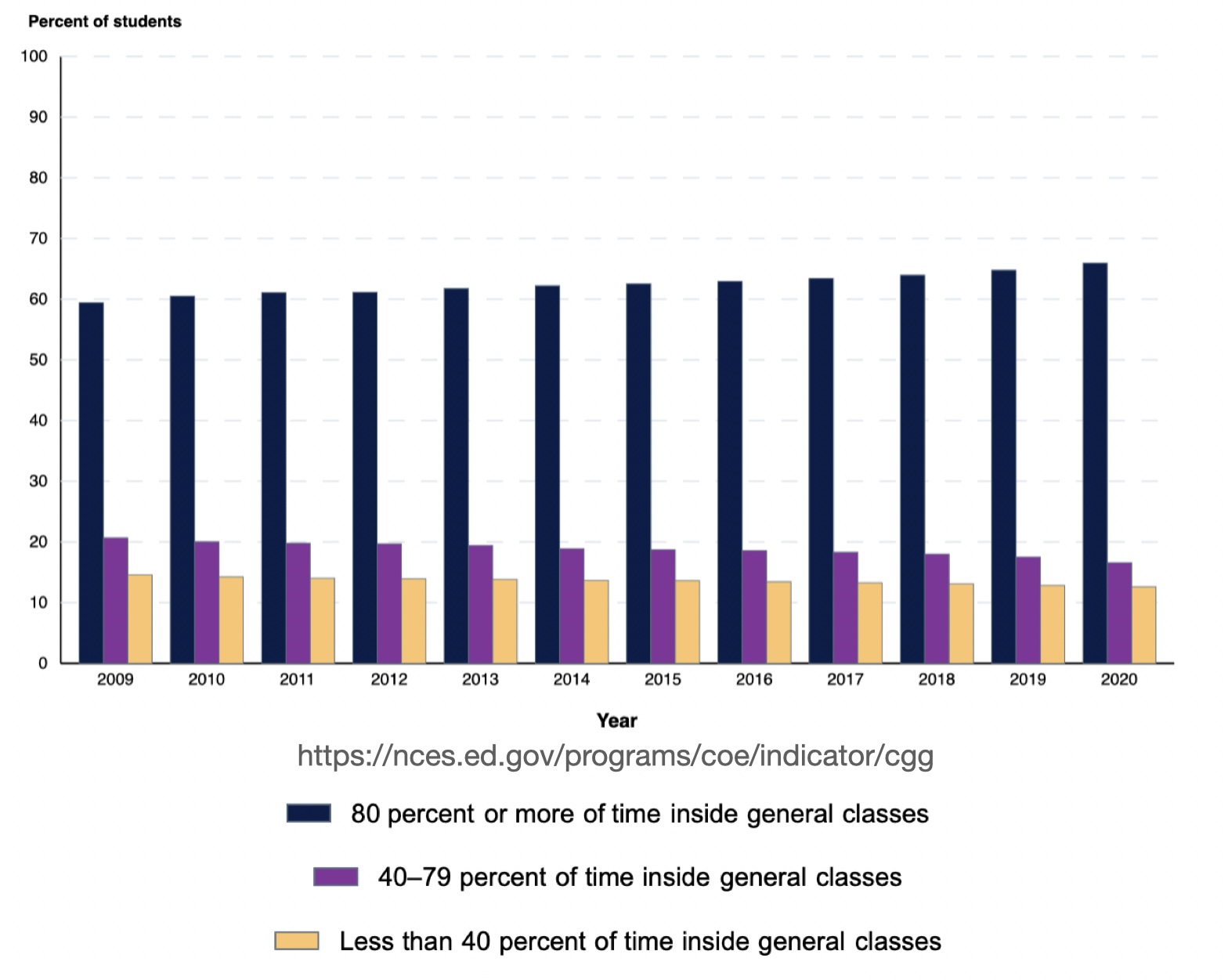
15% of students nationally receive some sort of special education services. 10% of THESE students spend less than 40% of their day in general education classes. (NCES, 2023)
Here is the question that I ask when planning: what happens to that student on the day they walk into a general education music class for the first time?
If their music instruction has been running on a completely separate track (different songs, different repertoire, a different musical world entirely) they will arrive without any shared reference points. The songs their classmates have been building on for two years will be unfamiliar. The routines, the musical vocabulary, the repertoire that has become common ground in the general education room will be foreign to them. The excitement will become contempt.
For a student already navigating the stress of a new environment, arriving without shared musical knowledge is one more barrier between them and belonging.
Age-appropriate song choice is part of transition planning. It is one of the most direct and least complicated ways you can prepare a student to walk into a new classroom and recognize something. To feel, even briefly, like they were already part of something before they arrived.
Where to start
This requires a few deliberate choices, made consistently.
**Audit what you’re already teaching.** Write down every song you’ve used with your self-contained classes this year. Next to each one, note the age range it was designed for. Then look at the list without explaining it to yourself. What do you see?
**Start with your general education curriculum.** Your self-contained students’ grade-level peers are already learning specific songs. Those are your starting songs. Use them. Adapt the procedures - slow the pacing, add visual supports, build in more repetition, use a choice board - but begin from the same repertoire.
**Ask the student.** What music do they hear at home? In the car? What does their older sibling play too loud? Musical preference is not a prerequisite skill. Every student has one, and most students with disabilities have never been asked about theirs in a music classroom setting.
**Lean on folk songs.** Public domain folk repertoire is culturally rich, structurally simple, and adaptable across a wide range of abilities and ages. A well-chosen folk song works for a kindergartener and a fifth grader, for different reasons and with different expectations. The reason these songs have lasted is because they support language the way we speak it and culture the way we live it.
**Check yourself in the moment.** Before you press play or begin leading a song, ask one question: would I use this with my general education class at this grade level? If the answer is no, sit with that for a second before you proceed.
A quick gut-check
Before adding a song to your self-contained rotation, ask:
- Would a same-age peer recognize this as music for their age?
- Would this student encounter this song outside of a special education setting?
- Am I choosing this because it’s appropriate or because it’s easy?
The lesson, again
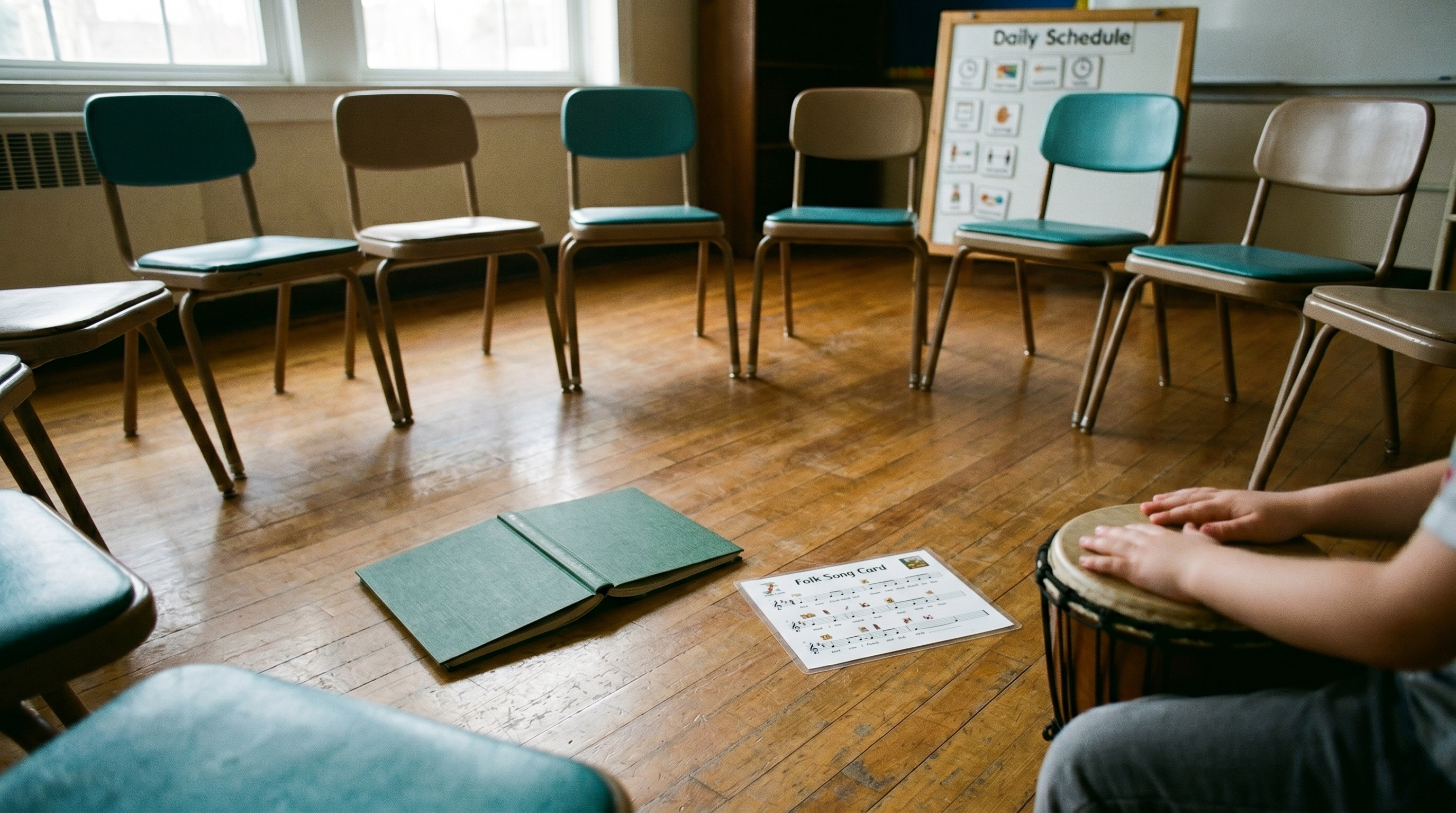
Picture the same class from the beginning of this post. Same room, same students, same Tuesday in November.
The structure is the same. The visual schedule is posted and everyone knows what comes next. The pacing is deliberate. The paraprofessionals are seated in the circle with the students. You are patient and warm and fully present.
The song is different.
It’s a folk song the third graders down the hall learned last month. This class is learning it too in their own way, on their own timeline, with the supports that make it accessible. The lesson is more work to plan the first time. After that, it isn’t.
And when one of these students eventually joins that third-grade class for music, they will already know that song. They will have been part of the same musical community all along, even when they were learning separately.
You chose that. That choice was yours.
That’s not a harder class to teach. It’s a more honest one.
References
VanWeelden, K., & Whipple, J. (2014). Music educators’ perceptions of preparation and supports available for inclusion. Journal of Music Teacher Education, 23(2), 33–51. https://doi.org/10.1177/1057083713484585